

Moving to Amsterdam: The Lazy Man's Guide
Pubished • Wed, Jan 14, 2026

Moving to Amsterdam:
The Lazy Man's Guide
For anyone chasing a better quality of life — without the endless forms, suspicious landlords, or apartments described as "cosy" when they really mean "you can touch all four walls from the centre of the room."
Let's get one thing straight: you're not moving to Amsterdam because it's cheap. Because it absolutely isn't. A coffee costs €3.50, a round at a bar will make you pause and reconsider your life choices, and the rental market operates as though supply is merely a suggestion. You're moving here because Amsterdam is one of the very few cities in Europe that still genuinely works — where the trams actually show up, where you can cycle to work without writing your will, and where, despite the eye-watering cost of everything, you somehow end up with a better quality of life than almost anywhere else.
This guide is written by someone who actually made the move, built a business here, and has spent over a decade helping international professionals do the same. No fluffy lifestyle content. No inspirational canal photography with vague captions about "finding yourself." Just the things you actually need to know — housing, bureaucracy, cost of living, neighbourhoods, and how to survive the first 90 days with your sanity reasonably intact.
The Money Talk: What You'll Earn vs. What Everything Costs
The average gross salary in Amsterdam sits around €53,000 per year — which sounds reasonable until you do the maths on rent, tax, and the discovery that a round of drinks for four somehow costs €45. Taxes are steep, the housing market is brutal, and yet most professionals who move here find that the combination of salary level, quality of life, and public infrastructure makes it genuinely worthwhile. Here's the honest version.
Dutch Income Tax in 2026
The Netherlands runs a progressive tax system with two main bands. Once you earn a decent salary, you're looking at anywhere from 37% to 49.5% income tax. This regularly causes the kind of visceral shock that temporarily puts people off the whole idea — but the trade-off is a healthcare system that won't bankrupt you, public infrastructure that mostly works, and a pension system that actually pays out.
| Income Bracket | Tax Rate (2026) |
|---|---|
| Up to €38,441Lower band — most entry-level and mid roles | 36.97% |
| €38,441 – €75,518Mid-senior professionals, team leads | 37.48% |
| Over €75,518Senior professionals, directors, specialists | 49.50% |
The 30% Ruling — Your Tax Break Lifeline
If you're arriving as a highly skilled migrant (kennismigrant), there's a decent chance you qualify for the 30% ruling — a scheme that allows your employer to pay 30% of your salary tax-free for up to five years. The threshold in 2026 is a gross salary of at least €48,013 per year (lower for researchers and those under 30 with a Master's degree). If you qualify, apply within four months of your start date or you lose it. It's genuinely one of the most valuable expat tax arrangements in Europe.
Note that the 30% ruling changed in 2024 — it now scales over time rather than remaining flat, so the benefit is strongest in the first years. If you're planning a long stay, factor this into your financial projections. For the full breakdown, see our guide to Dutch tax returns for expats.
Rent for a 1-bed apartment: €1,600–€2,200 · Health insurance: ~€159/month · Groceries: €300–€400 · Transport (OV card or bike): €0–€100 · Utilities if not all-inclusive: €150–€200 · Total before fun: roughly €2,300–€3,100/month. This is why the 30% ruling matters and why employers competing for international talent generally need to pay above average.
The good news: once you're earning in euros and living in the city's rhythm, Amsterdam's expensive reputation softens. You stop driving. You cycle, which is free. Lunch at a Dutch broodjeszaak is €5. You cook at home more than you expected. And the quality-of-life return on investment — the safety, the healthcare, the green spaces, the sheer functionality of the city — is genuinely difficult to match elsewhere in Europe.
Housing in Amsterdam: Where Realistic Expectations Come to Live
Amsterdam's rental market is, to use diplomatic language, challenging. To use honest language: it's one of the tightest in Europe, with high demand, limited supply, persistent scam activity, and landlords who can afford to be extremely selective. Private sector rentals represent only about 5–10% of the city's total housing stock — the rest is social housing reserved for Dutch residents on waiting lists measured in years, not months.
That said, people find accommodation here every day. The key is understanding the market, knowing where to look, moving quickly, and — critically — having your paperwork ready before you need it.
| Property Type | Typical Monthly Rent (2026) |
|---|---|
| Studio / bachelor apartment30–45m², city centre or nearby | €1,300 – €1,700 |
| 1-bedroom apartment45–65m², central locations | €1,600 – €2,200 |
| 1-bedroom, outside centreNoord, Oost, Nieuw-West | €1,400 – €1,800 |
| 2-bedroom apartment65–90m², family or sharers | €2,200 – €3,200 |
| Furnished serviced apartmentAll-inclusive, flexible contract | €1,800 – €2,800 |
Where to Search — Legitimately
If someone called "Anna" messages you on Facebook with a dream apartment at €900/month before you've even seen photos, that's not an apartment — that's a scam with a Dutch name attached. Stick to verified platforms and be honest with yourself about the market rates.
Funda.nl — The Dutch property market's main platform. Most professional landlords and agencies list here. Comprehensive, reliable, mostly free to browse. Pararius.com — Built specifically for the rental market, with a strong international-facing section. English-language listings, solid agency-backed inventory. Kamernet.nl — Better for room rentals and shared accommodation, good if budget is the priority. Competitive application process. HousingAnywhere — Designed for shorter furnished stays; useful for landing pads while you search for something longer-term.
Amsterdam's housing shortage has made it a prime target for rental fraud. The standard playbook: attractive photos, below-market price, landlord is "abroad" and can't do a viewing, just send a deposit and the keys will be posted. Never pay anything — deposit, first month, or "holding fee" — without physically viewing the property (or video call at minimum) and verifying the landlord's identity through official channels. Legitimate landlords don't ask for money up front before a viewing. Ever.
Furnished vs. Unfurnished — Choose Carefully
One thing that reliably surprises new arrivals: "unfurnished" in Amsterdam can mean bare floors, no light fittings, and sometimes no kitchen appliances. This isn't an exaggeration — it's a cultural norm rooted in the Dutch expectation that tenants bring their own everything. Budget for this if you go unfurnished. Furnished expat rentals in Amsterdam cost more per month but save you a significant outlay on setup costs and the considerable stress of furnishing a flat in a country where you don't yet have a bank account.
The Smart Arrival Strategy: Start with Temporary Accommodation
Here's the advice that most "moving to Amsterdam" guides skip: trying to find your long-term apartment from outside the Netherlands is extremely difficult and often leads to poor decisions made under pressure. The Amsterdam rental market rewards those who can view properties quickly, submit applications same-day, and move fast. You can't do any of that effectively from another country.
The better approach: arrive into temporary accommodation in Amsterdam that gives you a stable, registered base — and then find your long-term home properly, from within the city. Serviced apartments in Amsterdam work particularly well for this because they come fully furnished, include utilities, offer flexible contract lengths (no fixed minimum commitment), and — critically — provide a formal Dutch tenancy agreement that lets you register your address and get your BSN from day one.
The Practical Bit: Why Serviced Accommodation Matters on Arrival
City Retreat has been providing serviced accommodation in Amsterdam to expats, professionals, and international teams since 2012. Every apartment is fully furnished, all-inclusive on utilities, and comes with a formal Dutch tenancy agreement — which means you can register your address and get your BSN from the moment you move in. No hunting for an address, no waiting weeks before you can start the paperwork.
Most tenants use us either as a permanent solution (flexible 2-month minimum, no fixed end date) or as an organised landing pad while they find longer-term housing — typically 2–4 months. Either way, you arrive knowing exactly where you're living, and you can start the bureaucratic process immediately.
Amsterdam's Neighbourhoods: A Realistic Guide
Amsterdam is compact enough that neighbourhood choice is less critical than in most major cities — you can cycle almost anywhere in 20 minutes. But the vibe differences between areas are real, and knowing them before you commit to a contract saves you from the mild regret of realising you've moved to the wrong one. Here's an honest rundown.
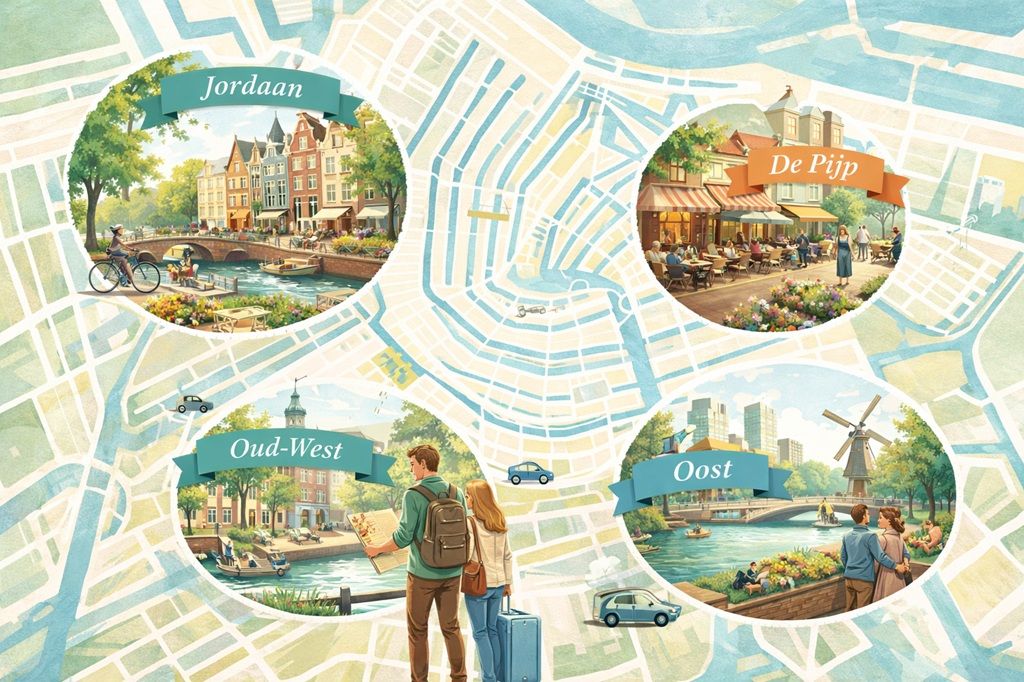
Architecturally stunning, historically significant, and perpetually swarming with tourists. The canal ring is UNESCO-listed and genuinely beautiful. Perfect for Instagram, less ideal for a peaceful Sunday morning or parking a bike without it being stolen.
Gentrified to within an inch of its life, beautiful, and priced accordingly. Independent boutiques, artisanal everything, the Foodhallen, and the Westerpark. Popular with creatives and expats who've been here long enough to afford it.
Young, loud, dense, and excellent. The Albert Cuyp Market, diverse restaurants on every corner, and a social energy that makes it the go-to for young professionals. Your neighbours will be friendly. You will hear them through the walls.
Leafy, calm, and very international. Vondelpark on the doorstep, international schools within reach, and the kind of neighbourhood that has multiple organic grocery stores and a yoga studio on every second corner. Also the Zuidas business district for easy commutes.
Authentically diverse, down-to-earth, and genuinely underrated. Oosterpark and Flevopark provide green space, the dining scene is excellent and unpretentious, and rents are more reasonable than the western neighbourhoods. Popular with those who've done their research.
Former industrial wasteland transformed into Amsterdam's creative hub. The NDSM wharf, spacious loft-style apartments, artists and tech professionals, and a free ferry across the IJ that takes 5 minutes. More space for your money than most of the city. The trade-off is the ferry, which is either charming or inconvenient depending on your mood.
If you're relocating with children, international school places in Amsterdam are seriously competitive — and expensive. The Amsterdam International School (AIS), British School of Amsterdam, and Amsterdam International Community School (AICS) all have waiting lists. Apply before you arrive. Tuition runs €24,000–€33,000 per year. Dutch public schools are free, excellent, and increasingly bilingual — worth serious consideration for families planning a longer stay. For a deeper look at Amsterdam's neighbourhoods and what suits different expat profiles, see our guide to Amsterdam's neighbourhoods.
Bureaucracy, BSN & Getting Officially Registered
This is the section people underestimate, which is ironic given that it's the thing that blocks everything else. In the Netherlands, there is a specific administrative sequence that needs to happen, in roughly the right order, before you can function as a normal adult in society. The good news: it's all doable. The less good news: it requires preparation, and Amsterdam's appointment availability means you need to start this process before you even land.
The Administrative Sequence
Get a Registerable Address
Before anything else, you need an address you can register at. This means a formal Dutch tenancy agreement on registered residential accommodation — not a hotel, not an Airbnb, not an unregulated sublet. This is the step that trips most people up. If you arrive into serviced accommodation in Amsterdam such as a City Retreat apartment, you have a formal tenancy contract from day one and can proceed immediately. If you're couch-surfing or in a hotel, you're stuck until you find a proper registered address.
Book Your Stadsloket Appointment — Immediately
Registration in Amsterdam takes place at one of the city's Stadsloket offices. Appointments currently run 6–8 weeks ahead of schedule. Book at amsterdam.nl (select "inschrijving vanuit het buitenland") or call 14 020 as soon as you have your move-in date confirmed. You are legally required to register within five days of arrival, so the system expects you to initiate this promptly even if your appointment is weeks away. Check all seven Amsterdam locations — wait times vary significantly between them. If you're a highly skilled migrant, IN Amsterdam (at Concertgebouwplein) can often book within 2–6 weeks and processes everything in a single appointment.
Attend the Appointment and Get Your BSN
Bring your passport or EU national ID, your signed tenancy agreement, and (if requested) your birth certificate — apostilled if it's from outside the EU. Staff speak English. The appointment takes around 30–45 minutes. At most Stadsloket offices you'll receive your BSN on the day or by post within 5–10 working days. Non-EU nationals must have initiated the IND process before registering.
Apply for DigiD
Your BSN unlocks DigiD — the Dutch government's digital identity system. Apply immediately at digid.nl. You'll receive an activation code by post within 3 working days. Without DigiD you can't access the Belastingdienst (tax authority), most healthcare portals, or a growing number of government services. It's free. Just do it the same day you get your BSN.
Get Health Insurance
Dutch health insurance is mandatory for everyone living or working in the Netherlands. You must sign up within four months of starting work or face backdated premiums. The average basic premium in 2026 is around €159/month. Major providers include Zilveren Kruis, VGZ, Menzis, and CZ. You'll need your BSN to sign up. Don't delay — the backdated fine is disproportionate to the inconvenience of just doing it early.
Open a Dutch Bank Account
Traditional banks (ABN AMRO, ING, Rabobank) require your BSN, proof of address, and ID. Processing can take a week or two. In the meantime, Bunq or N26 can be opened quickly for day-to-day use. Note: Dutch commerce still runs heavily on debit cards and iDEAL bank transfers. Credit cards have patchy acceptance. Get a Dutch debit card sorted as fast as you can — you will need it for everything from the supermarket to paying rent.
If you're coming from outside the EU/EEA, you need an IND (Immigration and Naturalisation Service) residence permit. Your employer typically initiates this as part of your hiring process. You cannot register at the Stadsloket without at minimum an IND appointment confirmation. Start this process as early as possible — IND processing times vary and can delay your entire administrative sequence.
For the complete step-by-step registration guide — including every document you need, all seven Stadsloket locations, the IN Amsterdam option, and a full FAQ — see our dedicated guide to registering in Amsterdam and getting your BSN.
Transport: Mostly Bikes, Occasionally Trams, Never a Car
Amsterdam's transport system is excellent, but the honest answer is that you'll spend roughly 80% of your time cycling. The city is flat, has an exceptional network of dedicated cycle lanes, and is compact enough that a bike covers most journeys faster than any other option. Amsterdam has more bicycles than people — around 1.3 bikes per resident. Refusing to cycle here isn't really an option. It's infrastructure.
Getting a Bike
Buy secondhand. New bikes get stolen (this is not a cautionary tale, it's a statistical certainty). A decent secondhand bike from a shop or Marktplaats.nl costs €80–€250. Get a good lock — ideally two. A U-lock plus a chain lock is the standard. Accept that at some point your bike will either be stolen or end up in a canal. This is the Amsterdam experience.
Public Transport: The OV-Chipkaart
Amsterdam's public transport network (trams, buses, metro, and ferries) is run by GVB and is genuinely good. The old chip card system has been updated — you can now tap in and out with your contactless bank card directly on most GVB services. A monthly unlimited OV-chipkaart costs €65–€145 depending on zones. Forget to tap out and you'll receive a fine of around €20 and a brief education in Dutch efficiency. For getting around the wider Netherlands, the NS train network is excellent and surprisingly affordable with an OV-jaarkaart (annual pass).
If you're living in Amsterdam Noord, the free ferries across the IJ (IJveer) are your primary connection to the city centre. They run frequently (every 5–10 minutes at peak times) and take about 5 minutes. Charming in good weather. Less charming at 7am in January horizontal rain. You'll form an opinion quickly.
For a full breakdown of getting around Amsterdam by tram, metro, bus, bike, and ferry — including tips on the GVB app and the best routes from different neighbourhoods — see our transport guide for expats in Amsterdam.
Healthcare: How It Works and What It Costs
The Dutch healthcare system is good. It's not perfect — accessing specialist care involves a referral chain that can feel bureaucratic — but the basic care is solid, the GPs are competent and mostly English-speaking, and you won't be financially destroyed by a hospital visit. The system is insurance-based: you pay a monthly premium to a private insurer, and the government sets minimum coverage standards that all insurers must meet.
Key Facts for 2026
Basic premium: Around €159/month. You also pay an annual excess (eigen risico) of €385, which means the first €385 of non-GP care each year comes out of your pocket before insurance kicks in. Dental care for adults is not included in basic insurance — you'll need supplementary cover or pay out of pocket. Major insurers include Zilveren Kruis, VGZ, CZ, and Menzis. Shop around on independer.nl before committing.
Register With a GP (Huisarts)
In the Netherlands, your huisarts (GP) is the gatekeeper to the entire healthcare system. You can't see a specialist without a referral from your GP. Register with one near your address as soon as possible — most practices are accepting new patients, and it only requires proof of address and your insurance details. For emergencies outside GP hours, call the huisartsenpost. For genuine emergencies only, go to the spoedeisende hulp (A&E). The Dutch definition of "emergency" is narrower than you might be used to — a broken finger probably doesn't qualify, in their view.
For the full guide to navigating Dutch healthcare as an expat — from choosing an insurer to registering with a GP and handling dental care — see our dedicated Amsterdam healthcare guide for expats.
Food, Drink, and Actually Enjoying the City
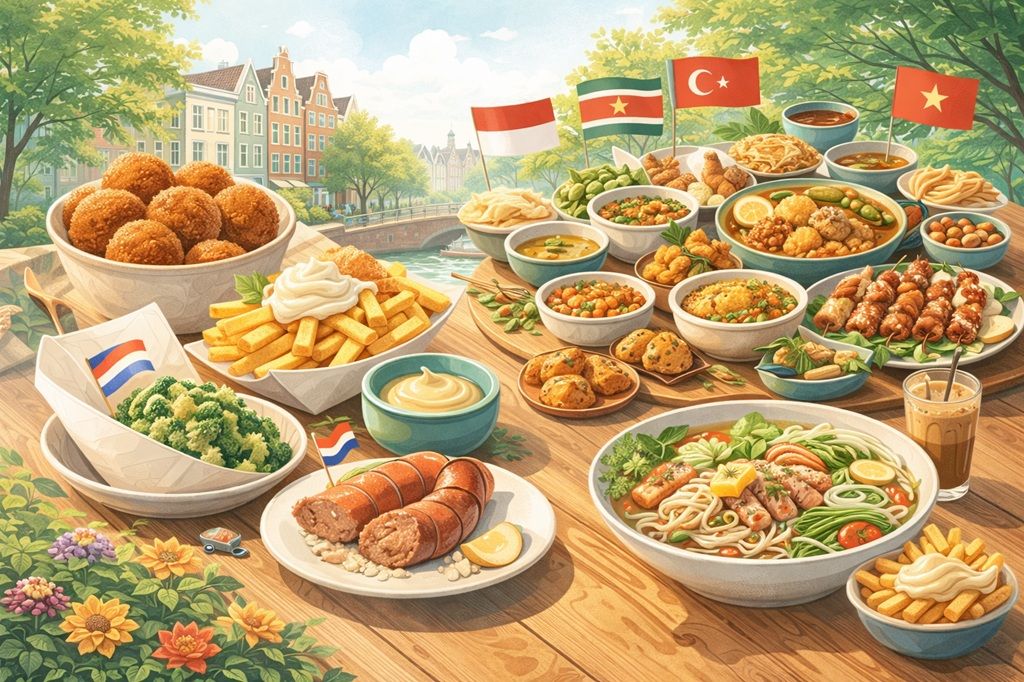
Enough about bureaucracy. You're moving to Amsterdam, and despite the paperwork, the rent, and the weather (more on that shortly), it's genuinely one of the most enjoyable cities in Europe to live in. Here's the actual good bit.
Food: Better Than You Expect
Traditional Dutch cuisine is honest, hearty, and not much to write home about — herring, stamppot, bitterballen, frites met mayo. These are fine. Some of them are excellent. None will make you reconsider your life. What will make you reconsider your life is the international food scene, which is genuinely world-class. Amsterdam's history as a trading city means the Indonesian (rijsttafel), Surinamese, Turkish, and Vietnamese restaurants are extraordinary. The high-end dining scene is solid. The coffee is excellent. And yes, you will eventually develop an appreciation for mayonnaise on chips. It happens to everyone.
Drinking: Cafés, Craft Beer, and Brown Bars
Brown cafés (bruine kroegen) are Amsterdam's contribution to civilisation — cosy, unfussy, low-lit, wood-panelled neighbourhood pubs where locals drink like it's 1957 and no one is performing for an audience. They're excellent. Seek them out over the tourist-facing options. For craft beer, Brouwerij 't IJ (inside a windmill, obviously) and Oedipus Brewing are both good. For rooftop cocktails at €18 each, the W Lounge and A'DAM Tower offer panoramic views and the opportunity to recalibrate what you're willing to spend on a drink.
Nightlife & Festivals
Amsterdam's club scene is one of Europe's best — Shelter, Radion, Panama, and CLAIRE are all serious venues. If you're into electronic music, you've moved to the right city. For festivals: Awakenings, Dekmantel, DGTL, and Milkshake are all genuinely good and chaotic in the best possible way. And then there's King's Day (27 April) — less a public holiday, more a city-wide collective fever dream in orange that needs to be experienced rather than described.
Making Friends: A Realistic Note
Dutch people are not cold. They are refreshingly direct and efficient with social interactions, which can initially read as aloofness to anyone from a culture where "we should get a coffee sometime" is a genuine invitation rather than a polite noise. Once you've cleared the initial formality — usually about three to six months in — Dutch friendships are genuine, loyal, and involve a lot of cycling to unusual locations together. The fastest routes to a social life in Amsterdam: join a sports club or class (padel, football, hockey, rowing — Amsterdam has everything), sign up for Dutch language lessons (shared suffering builds bonds), or attend meetups through InterNations or Meetup.com. The expat community is enormous and generally friendly to newcomers.
If you're moving in April or May, you've timed it perfectly. Amsterdam in spring is unfairly beautiful — the canals, the blossom, the terraces, King's Day. If you're arriving in November, invest in a waterproof jacket and accept the situation. Amsterdam's autumn and winter are genuinely beautiful in a different way, but they require a different attitude. For spring-specific tips on experiencing Amsterdam as a new arrival, see our Spring in Amsterdam guide.
The Amsterdam Arrival Timeline
This is the order things need to happen. Deviate from it at your own peril.
Frequently Asked Questions
Yes — with clear eyes. Amsterdam consistently ranks among Europe's most liveable cities, with excellent infrastructure, a very large and welcoming international community, world-class cycling, and over 90% of residents speaking English. The main challenges are the housing market (genuinely difficult) and the cost of living (high but manageable at professional salary levels). For skilled professionals, the combination of salaries, the 30% ruling, and quality of life makes it a genuinely compelling city to live in.
Practically speaking, no — you can live, work, and socialise entirely in English and manage very well. Over 90% of Amsterdammers speak English, most government services have English options, and the international community is enormous. However, learning basic Dutch makes a meaningful difference to how quickly you integrate, and it's genuinely appreciated by locals. There's also one practical consideration: the Dutch tax authority (Belastingdienst) operates primarily in Dutch, so having at least basic comprehension saves frustration down the line.
Trying to find a long-term apartment remotely before arriving, usually under pressure, and making a poor decision (or falling victim to a scam). The Amsterdam rental market requires in-person viewings, fast responses, and a full documentation package ready to go. The far better approach is to arrive into temporary or short-term accommodation in Amsterdam on a proper registered contract, get your administration sorted from that base, and then search for long-term housing properly from within the city. The second most common mistake is underestimating how long the BSN registration appointment takes to book.
Yes — if the accommodation is registered residential property and your contract is a formal Dutch tenancy agreement. City Retreat's serviced apartments in Amsterdam all meet this requirement. Hotels, Airbnbs, and many informal sublets do not — which is one of the most important practical differences between registered serviced accommodation and tourist-type rentals. If you can't register your address, you can't get your BSN, which blocks everything else.
Under Amsterdam municipality rules, "short-stay" or "short-term rental" refers to tourist rentals under 30 nights, which are heavily regulated and largely restricted. This is why reputable expat housing providers (including City Retreat) operate on minimum 2-month furnished contracts — these are classified as medium-term residential rentals, not tourist short-stay, and are entirely legal and registerable. Any serviced accommodation in Amsterdam offering proper registration support will be operating under this legal framework.
Honest answer: the first month is largely administrative survival. Month two is when you start to relax. By month three, you know your neighbourhood, you have a GP, a bike, a bank account, and at least a few acquaintances becoming friends. Most expats say they genuinely feel at home somewhere around the six-month mark — which is when the city stops feeling like an obstacle course and starts feeling like, well, home. Amsterdam rewards patience and engagement.
Ready for a Smooth Start?
The difference between a stressful arrival and an organised one usually comes down to one thing: having a proper place to land. Every City Retreat apartment comes fully furnished, all-inclusive on utilities, and with BSN registration support from day one. Expat rentals in Amsterdam don't have to be complicated.
View Available Apartments